
How to Track Vehicles in Remote Australia — Where Mobile Coverage Fails
If you manage a fleet that operates beyond the reach of Australia’s mobile networks, you already know the problem. Your driver leaves the depot heading into the Pilbara, the Kimberley or outback Queensland — and within an hour, they’ve disappeared off the radar.

No GPS ping. No check-in call. No way to know if they’re safe, on schedule or in trouble.

For fleet operators across mining, exploration, transport and agriculture, this isn’t an edge case. It’s a daily reality. And the solutions that have existed until now — expensive satellite phones, UHF radios, or simply hoping for the best — have never truly solved it.

This article explains the landscape of remote vehicle tracking in Australia, why traditional solutions fall short, and how modern Starlink-powered technology is changing everything.

Why Mobile Coverage Fails in Remote Australia

Australia is the sixth largest country in the world by area, but its mobile network infrastructure is overwhelmingly concentrated in coastal and metropolitan regions. According to the ACMA, mobile networks cover approximately 75% of the Australian population — but only around 25% of the land mass.

For fleet operators working in remote areas, this means vast stretches of road, station and mine site where standard 4G GPS tracking simply stops working. The tracker may be installed and functioning perfectly — but without a mobile signal to transmit data, it goes dark.

This affects operations across:

  • Mining and resources — Pilbara, Kimberley, Goldfields and remote NT
  • Pastoral and agricultural stations across outback WA, QLD, SA and NT
  • Road transport on remote highways including the Great Northern, Stuart and Barkly
  • Exploration and survey teams working in unmapped or low-infrastructure areas
  • Construction and civil projects in regional and remote locations


The Old Solutions — and Why They Fall Short

Satellite Phones

Satellite phones have been the traditional answer for remote communication. They work — but they come with significant drawbacks. Hardware costs are high, monthly plans are expensive, and critically, most drivers find them cumbersome to use. When a driver needs to call base, they have to stop, retrieve the handset, and make a deliberate call. In practice, many don’t.

UHF Radio

UHF radios are widely used on mine sites and in pastoral operations. They’re effective at short range and within a site — but useless across the distances involved in road transport. A driver heading from Tom Price to Newman on a 200km run is well beyond UHF range within minutes.

Personal Locator Beacons (PLBs)

PLBs are emergency-only devices. They indicate distress but provide no ongoing tracking, no voice communication and no operational visibility. They’re a last resort, not a fleet management tool.

Periodic Check-Ins

Many operations still rely on scheduled radio or phone check-ins at set intervals. This works until it doesn’t — and the window between a missed check-in and a response can be dangerously long in remote environments.


How Starlink Changes Remote Vehicle Tracking

SpaceX’s Starlink low-Earth orbit satellite network has fundamentally changed what’s possible for remote connectivity in Australia. Unlike geostationary satellites that suffered from high latency and limited bandwidth, Starlink provides fast, low-latency internet connectivity across virtually all of Australia — including areas with zero mobile coverage.

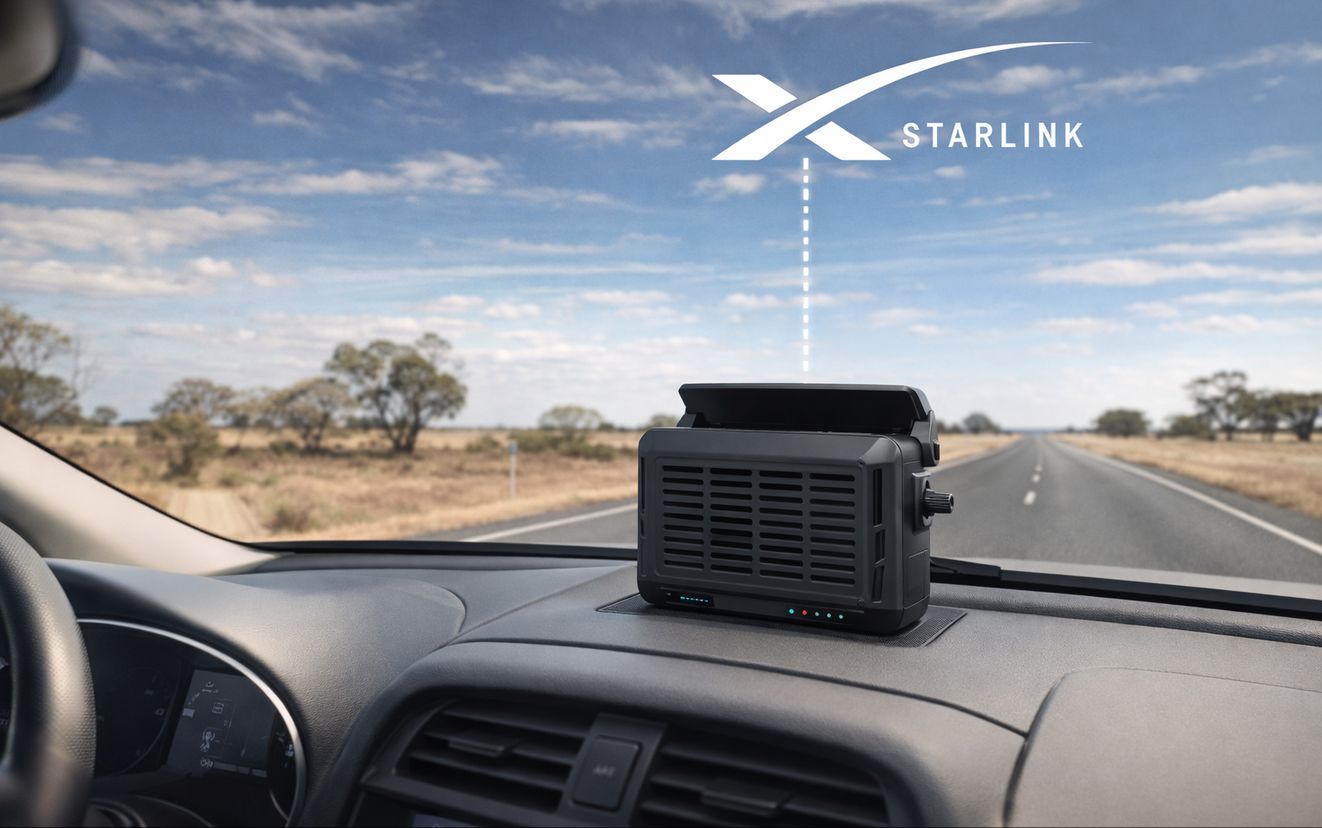
The Starlink Mini hardware unit is compact enough to install inside a vehicle cab. Once connected, it provides a stable internet connection that supports GPS data transmission, live video streaming and voice communication — all simultaneously.

This is the technology that powers CVMS — the Connected Vehicle Monitoring System from GPS Trackers Australia.


What CVMS Delivers for Remote Fleet Operations

CVMS combines Starlink connectivity with a fully integrated fleet monitoring platform. Here is what it delivers in practice:

  • Live GPS tracking — your operations team can see the exact position of every vehicle in real time, anywhere in Australia, regardless of mobile coverage
  • Dashcam video streaming — live video feed from the vehicle’s front camera, viewable from any device at base
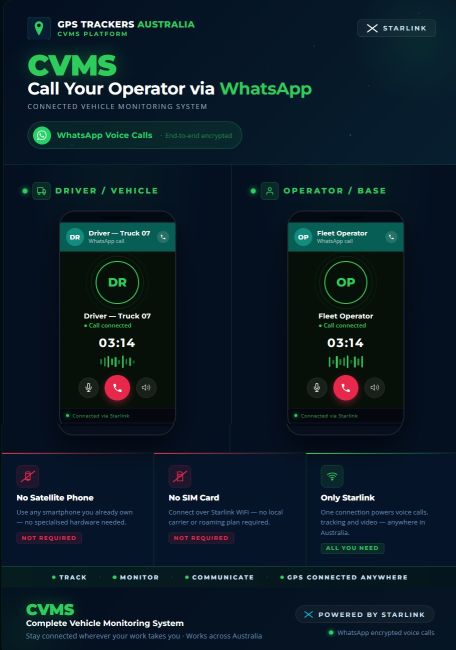
  • WhatsApp voice calls — drivers can call base directly through WhatsApp using the Starlink connection. No satellite phone contract required. No SIM card needed. Just the app they already have on their phone
  • Real-time alerts — speed alerts, geofencing notifications, harsh braking events and driver fatigue detection
  • Automated reporting — trip history, route replays and compliance reporting all generated automatically


The CVMS Difference — No Satellite Phone, No SIM Card

The most significant practical difference between CVMS and legacy remote tracking solutions is the communication method. By using WhatsApp over Starlink, CVMS eliminates the need for a dedicated satellite phone entirely.

For drivers, this means using the smartphone they already carry — an app they’re familiar and comfortable with. For operations managers, it means a direct voice line to every driver, from base, at any time.

The cost difference is also significant. Satellite phone plans can cost several hundred dollars per month per device. CVMS operates on a single Starlink connection at a fraction of that cost.


Is CVMS Right for Your Remote Fleet?

CVMS is designed for any operation that moves vehicles through areas with limited or zero mobile coverage. If your fleet operates in remote or regional Australia — whether in mining, transport, exploration, agriculture or construction — CVMS provides the visibility and communication capability that standard GPS trackers cannot.

The system is available as a complete kit including hardware, Starlink connectivity and platform access, on a month-to-month basis with no lock-in contracts.

To learn more or book a free demonstration, visit www.gpstrackersaustralia.au or call 02 8764 0753.

Starlink Fleet Tracking Explained — How It Works, What It Costs, and Who It’s For

Starlink Fleet Tracking Explained, Starlink fleet tracking Australia,CVMS integrates with Starlink

Starlink has been one of the most talked-about technologies in remote Australia over the past two years. For homesteads, stations and regional businesses, it has provided internet access where none existed before. But for fleet operators, Starlink represents something even more transformative — the ability to track, monitor and communicate with vehicles anywhere in the country.

This article explains how Starlink fleet tracking works, what hardware is involved, what it costs, and whether it’s the right solution for your operation.

What is Starlink and How Does It Work?

Starlink is a low-Earth orbit (LEO) satellite internet service operated by SpaceX. Unlike traditional geostationary satellites that sit at 35,000km altitude, Starlink satellites orbit at between 340km and 1,200km — much closer to Earth. This proximity dramatically reduces latency and increases connection speeds.

As of 2026, Starlink operates more than 6,000 satellites globally, providing coverage across virtually all of Australia including remote outback regions that have never had reliable internet connectivity.

For fleet tracking purposes, Starlink provides the connectivity layer — a reliable internet connection that allows GPS data, video feeds and voice communication to be transmitted from a moving vehicle anywhere the satellite network reaches.

What Hardware Is Required for Starlink Fleet Tracking?

For in-vehicle fleet tracking using Starlink, the key piece of hardware is the Starlink Mini. This is a compact, portable version of the standard Starlink dish unit that is designed for mobile and portable applications. Key specifications:

  • Dimensions: 298mm x 258mm x 38mm — compact enough to mount inside a vehicle cab
  • Weight: 1.1kg
  • Power consumption: 20-40W typical
  • Data speeds: 50-150Mbps download, 10-25Mbps upload
  • Latency: 25-60ms — sufficient for real-time video streaming and voice calls


The Starlink Mini connects to a vehicle’s power supply and provides a Wi-Fi hotspot that other devices — dashcams, GPS trackers, smartphones — can connect to, using that connection to transmit data.

What Does CVMS Add on Top of Starlink?

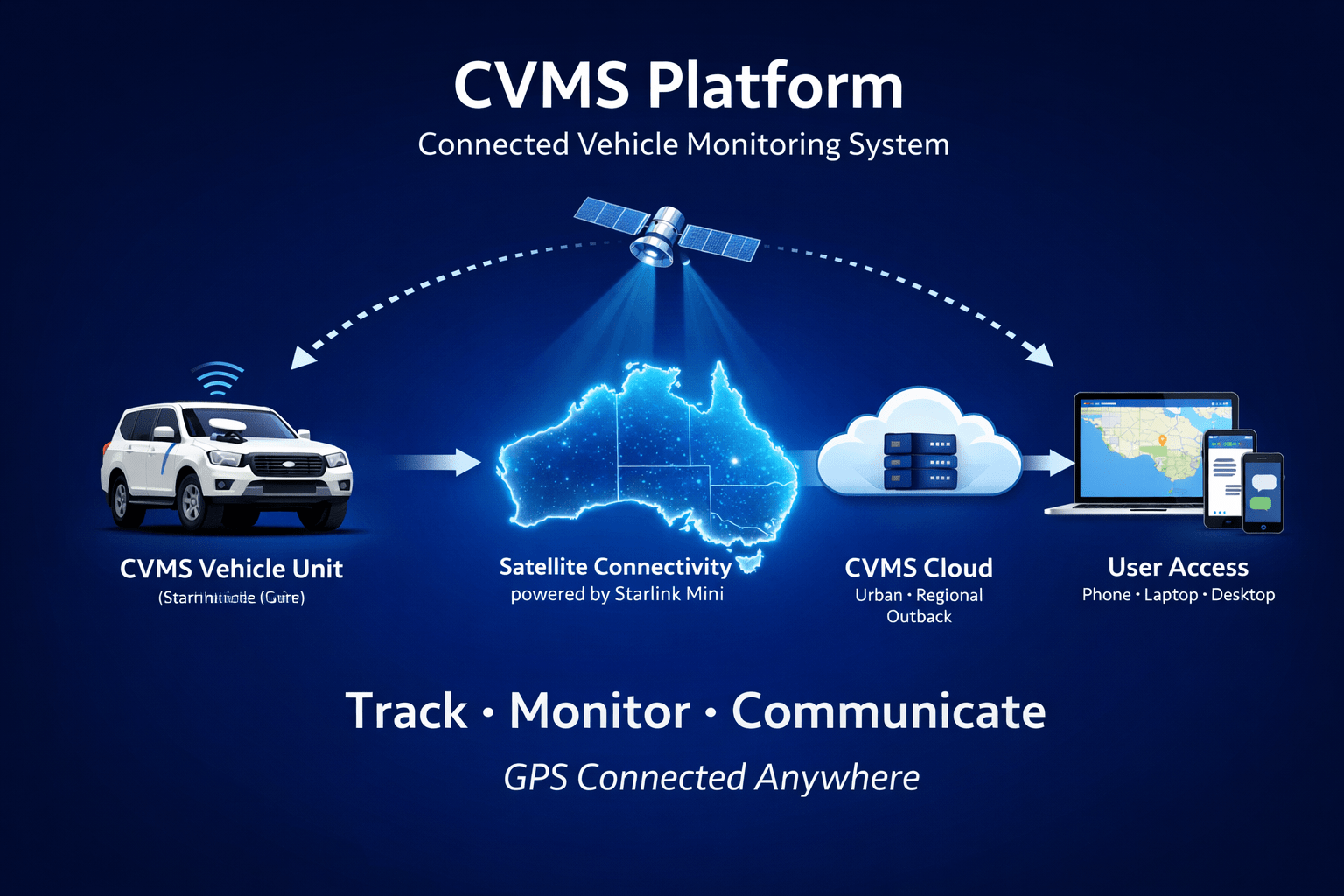
Starlink itself is just the connectivity layer — the internet pipe. CVMS (Connected Vehicle Monitoring System) from GPS Trackers Australia is the platform that uses that connectivity to deliver fleet tracking, monitoring and communication functionality.

CVMS integrates with Starlink to provide:

  • Real-time GPS tracking with route history and trip playback
  • Live dashcam video streaming — AI Dashcam V3 with driver monitoring capability
  • WhatsApp voice calls from driver to base — using the Starlink internet connection
  • Speed alerts, geofencing, harsh event detection
  • Driver fatigue monitoring through ADAS and DMS camera technology
  • Automated fleet reports and compliance documentation


How Much Does Starlink Fleet Tracking Cost?

The CVMS complete fleet kit is priced at $950 setup plus $120 per month, per vehicle. This includes:

  • Starlink Mini hardware
  • AI Dashcam V3
  • GPS tracking device
  • Starlink connectivity plan
  • CVMS platform access
  • Installation support


There are no lock-in contracts. The service operates on a month-to-month basis.

By comparison, a satellite phone plan for equivalent functionality typically costs $300-500 per month plus hardware — making CVMS significantly more cost-effective, while delivering far more capability.

Which Industries Benefit Most from Starlink Fleet Tracking?

Any industry that operates vehicles in remote or regional Australia can benefit from Starlink-powered fleet tracking. The highest-impact applications are:

  • Mining and resources operations — particularly in remote WA, NT and QLD where mobile coverage is absent
  • Long-haul transport on remote highways
  • Exploration and survey teams
  • Agriculture and pastoral operations
  • Construction and civil contractors working on remote or regional projects
  • Emergency and response services operating in low-coverage areas


Getting Started

GPS Trackers Australia supplies and supports CVMS across all of Australia. The system can be installed in any vehicle and is ready to operate from day one.

For more information or to arrange a demonstration, visit www.gpstrackersaustralia.au or call 02 8764 0753.



Driver Fatigue Monitoring for Mining Fleets — How ADAS and DMS Technology Works

Driver safety, fleet monitoring, fleet visibility

Driver fatigue is one of the most significant safety risks facing the Australian mining and resources industry. Long shifts, remote locations, and demanding driving conditions create an environment where fatigue-related incidents are not just possible — they are a documented and ongoing operational concern.

Traditional approaches to managing driver fatigue — scheduling policies, self-reporting, and manual supervision — are important but insufficient on their own. Technology now exists that monitors driver fatigue in real time, from inside the vehicle, and alerts both the driver and the operations centre before an incident occurs.

This article explains how ADAS and DMS camera technology works, what it detects, and how it integrates with the CVMS fleet monitoring platform.

What is Driver Fatigue and Why Is It a Mining Industry Problem?

Driver fatigue refers to the physical and mental exhaustion that impairs a driver’s alertness, reaction time and decision-making. In mining operations, several factors compound the risk:

  • Extended shift patterns — 12-hour shifts are standard across much of the industry
  • Drive-in, drive-out (DIDO) and fly-in, fly-out (FIFO) rosters that disrupt circadian rhythms
  • Long distances between accommodation, site and town
  • Pre-dawn starts and late night finishes
  • Monotonous roads with limited stimulation


Safe Work Australia data consistently identifies fatigue as a contributing factor in a significant proportion of serious transport incidents in the resources sector. Duty of care obligations under Australian workplace health and safety legislation require employers to take all reasonably practicable steps to manage this risk.

What is ADAS? (Advanced Driver Assistance System)

ADAS stands for Advanced Driver Assistance System. In the context of fleet safety cameras, ADAS refers to a forward-facing camera system that monitors the road ahead and detects specific risk events using computer vision and AI processing.

The ADAS camera in CVMS detects and alerts on:

  • Forward collision warning — identifies when the vehicle is approaching another vehicle or obstacle at a dangerous closing rate
  • Lane departure warning — detects when the vehicle drifts out of its lane without signalling
  • Following distance alert — monitors the gap between the vehicle and the one ahead
  • Pedestrian detection — identifies pedestrians or cyclists in the vehicle’s path


When any of these events are detected, the system triggers both an in-cab alert to the driver and a notification to the fleet management platform — creating a real-time record of the event.

What is DMS? (Driver Monitoring System)

DMS stands for Driver Monitoring System. Unlike ADAS which watches the road ahead, the DMS camera is cabin-facing — it monitors the driver directly.

Using AI-powered computer vision, the DMS camera analyses the driver’s face and eye movements in real time to detect:

  • Microsleep events — brief, involuntary sleep episodes often undetected by the driver
  • Eye closure percentage — monitoring how frequently and how long the driver’s eyes are fully or partially closed
  • Head nodding — characteristic fatigue behaviour where the head drops forward
  • Distracted driving — looking away from the road for extended periods
  • Mobile phone use — detecting phone handling while driving
  • Seatbelt non-compliance


When a fatigue event is detected, the system responds with:

  • An immediate in-cab audible and visual alert to the driver
  • A real-time notification to the fleet management platform
  • An automatic video clip captured and stored for review


How This Integrates with CVMS

The AI Dashcam V3 in the CVMS complete fleet kit combines both ADAS and DMS functionality in a single device. The dashcam integrates fully with the CVMS fleet management platform, meaning all fatigue and safety events are:

  • Recorded automatically with timestamps and GPS location
  • Visible to operations managers in real time from any device
  • Stored for compliance documentation and incident investigation
  • Available for driver coaching and safety review


In remote operations where vehicles are operating far from supervision — exactly the environments where fatigue risk is highest — this real-time visibility gives operations teams the ability to intervene before an incident occurs rather than investigating after.

Meeting Your Duty of Care Obligations

Under Australian work health and safety law, employers have a primary duty to ensure the health and safety of workers, so far as is reasonably practicable. For remote fleet operations, this includes managing the risk of fatigue-related incidents.

CVMS with ADAS and DMS camera technology provides documented evidence that your organisation is actively monitoring and managing fatigue risk — which is both the right thing to do and a defensible position in the event of an incident investigation.

To discuss how CVMS can support your fatigue management program, visit www.gpstrackersaustralia.au or call 02 8764 0753.
 

Fleet Tracking for Transport and Logistics in Australia — What Modern Operations Need

video telematics,GPS data continues to be transmitted, voice connectivity in remote areas

Australia’s transport and logistics sector moves more freight across more distance than almost any comparable industry in the world. From metropolitan last-mile delivery to long-haul interstate runs and remote outback freight routes, Australian transport operators face a unique combination of operational demands, regulatory requirements and geographic challenges.

Fleet tracking technology has evolved significantly over the past decade. Where GPS tracking once simply meant knowing where a vehicle was, modern connected fleet platforms deliver real-time visibility, driver monitoring, compliance documentation and communication — all from a single integrated system.

This article outlines what contemporary transport and logistics operations need from a fleet tracking solution, and how CVMS addresses those needs.

Real-Time Vehicle Location

The foundational requirement for any fleet tracking system is accurate, real-time GPS location. For transport and logistics operations, this means:

  • Knowing the exact position of every vehicle at any given moment
  • Monitoring progress against route and schedule
  • Providing accurate ETAs to customers and receiving depots
  • Responding quickly when a vehicle deviates from its planned route


CVMS delivers live GPS tracking with map visualisation accessible from any device — desktop, tablet or mobile. Trip history and route replay allow operations managers to review completed journeys in detail.

Coverage in Remote and Regional Areas

For long-haul transport operators, one of the most significant limitations of standard 4G GPS tracking is coverage drop-out on remote routes. The Great Northern Highway, the Stuart Highway, the Nullarbor, the Barkly — these are commercial freight arteries where mobile coverage is patchy at best and absent for long stretches.

CVMS addresses this through Starlink connectivity. The Starlink Mini unit installed in the vehicle provides satellite internet coverage across virtually all of Australia, meaning GPS data continues to be transmitted and dashcam video continues to stream even in zero mobile coverage areas.

For transport operators running freight to remote mine sites, stations or communities, this is the difference between operational visibility and a blind spot.

Dashcam and Video Monitoring

Video telematics has become a standard expectation for professional transport fleets. Forward-facing dashcam footage provides:

  • Evidence in the event of an accident or near-miss
  • Protection against false liability claims
  • Driver coaching material for improving safety performance
  • Documentation for insurance purposes


The CVMS AI Dashcam V3 provides both live streaming (viewable from base in real time) and recorded footage stored for later review. ADAS functionality adds automated detection of dangerous driving events including forward collision risk and lane departure.

Driver Behaviour Monitoring

Fuel costs, maintenance costs and insurance premiums are all directly affected by driver behaviour. Harsh braking, rapid acceleration, speeding and excessive idling add up to significant operational costs at scale.

CVMS monitors and records driver behaviour events automatically, providing operations managers with:

  • Individual driver scorecards
  • Fleet-wide behaviour trends
  • Automated alerts for serious events
  • Data to support driver coaching conversations


Compliance and Reporting

Transport operators in Australia operate under a range of compliance obligations including Chain of Responsibility (CoR) requirements, work and rest hour regulations and vehicle maintenance schedules. CVMS supports compliance through automated reporting that documents:

  • Vehicle locations and routes
  • Trip start and end times
  • Speed events and driving behaviour
  • Fatigue monitoring events


All data is stored and accessible for the purposes of compliance audits, incident investigations and regulatory reporting.

WhatsApp Communication via Starlink

For long-haul drivers on remote routes, communication with base has traditionally relied on UHF radio (limited range) or mobile phone (dependent on coverage). CVMS enables drivers to communicate with base via WhatsApp using the Starlink connection — from anywhere in Australia.

This means operations managers can speak directly with drivers without relying on mobile coverage, and drivers can report issues, request assistance or provide updates in real time, regardless of where they are on the route.

One System, One Monthly Cost

CVMS is available as a complete fleet kit — hardware, connectivity and platform — for $950 setup plus $120 per month per vehicle, with no lock-in contracts.

For transport and logistics operators, this represents a single predictable cost per vehicle that covers GPS tracking, dashcam monitoring, Starlink connectivity and driver safety monitoring — replacing what would otherwise require multiple separate systems and subscriptions.

For more information, visit www.gpstrackersaustralia.au or call 02 8764 0753.
 

GPS Fleet Tracking for Construction and Field Services — Managing Vehicles Across Multiple Sites

Construction and field service operations present a distinct set of fleet management challenges. Unlike transport fleets that follow defined routes, construction vehicles move between job sites, depots and suppliers on variable schedules. Equipment may be deployed across multiple sites simultaneously. Workers may be operating in remote or low-infrastructure locations far from supervisory oversight.

For construction businesses, the ability to know where every vehicle and piece of equipment is — in real time, from a single platform — is not just an operational convenience. It’s a safety requirement, a compliance tool and a cost management mechanism.

This article outlines the specific fleet tracking needs of construction and field service operations and how CVMS addresses them.

Multi-Site Vehicle Visibility

A construction company with five active projects may have vehicles, machinery and personnel spread across multiple locations simultaneously. Without a connected fleet platform, operations managers rely on phone calls, check-ins and manual scheduling to understand where resources are.

CVMS provides a single map view of all vehicles across all sites in real time. Operations managers can see:

  • Which vehicles are on which site at any given time
  • How long vehicles have been on site
  • Whether vehicles are moving or stationary
  • Route history for any vehicle over any date range


Geofencing for Site Management

Geofencing allows operators to define virtual boundaries around job sites, depots or restricted areas. When a vehicle enters or exits a geofenced zone, CVMS generates an automatic alert.

For construction operations, geofencing provides:

  • Automatic site arrival and departure records — eliminating manual timesheet errors
  • Alerts when vehicles enter restricted or hazardous areas
  • After-hours movement alerts — notification when vehicles move outside of scheduled working hours
  • Equipment theft detection — immediate alert if plant or machinery is moved unexpectedly


Remote and Regional Job Sites

Construction projects in regional and remote Australia — road construction, infrastructure, mining services, energy — often operate in areas with limited or no mobile coverage. Standard 4G GPS trackers lose connectivity and go dark in these environments.

CVMS uses Starlink connectivity to maintain GPS data transmission and communication capability regardless of mobile coverage. For construction companies working on remote projects, this means:

  • Continuous vehicle tracking even in zero-coverage areas
  • Live dashcam access from remote sites
  • WhatsApp communication with field teams via Starlink — no satellite phone required
  • Real-time safety monitoring for remote workers


Plant and Equipment Monitoring

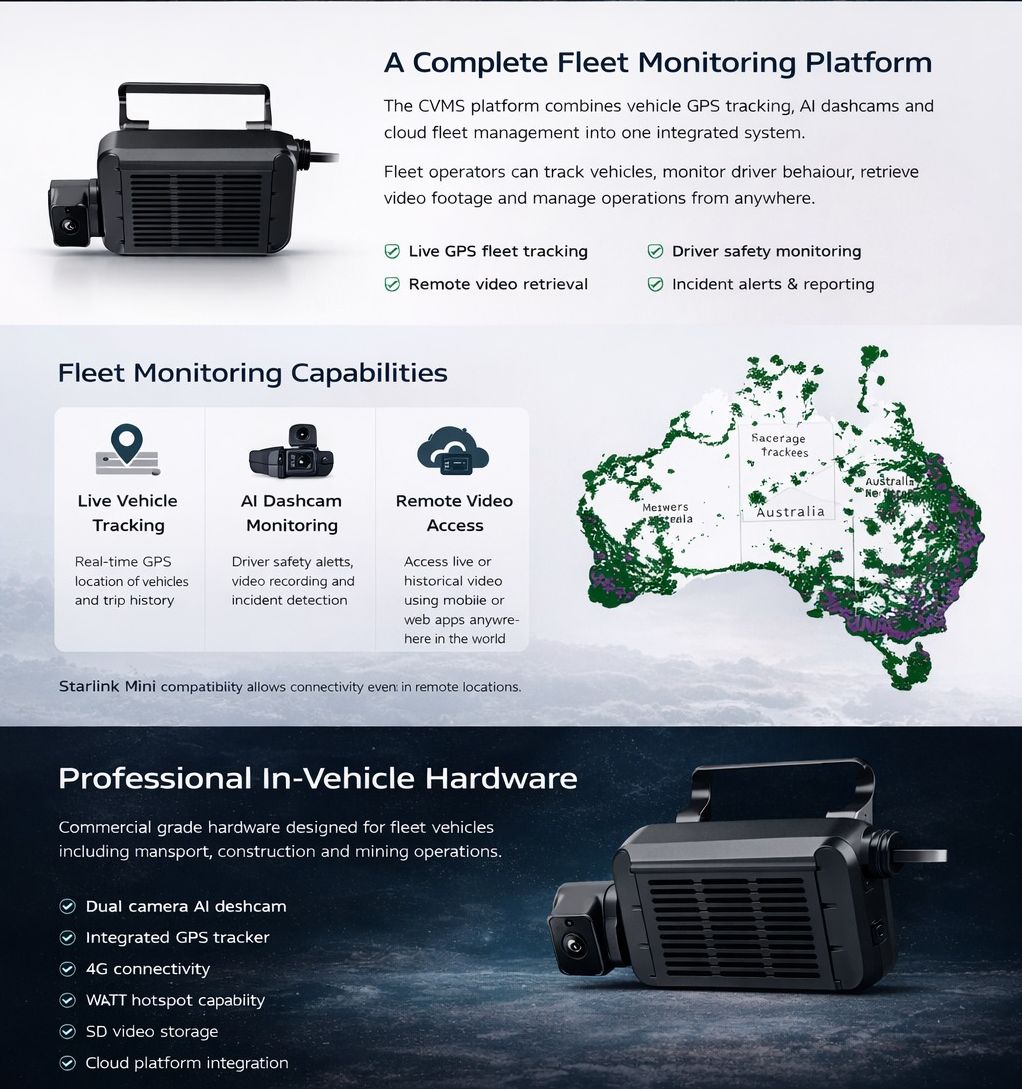
Beyond wheeled vehicles, construction businesses operate significant fleets of plant and equipment — excavators, graders, compactors, generators and more. CVMS GPS tracking devices can be installed on any vehicle or piece of equipment, providing:

  • Location tracking for all assets
  • Utilisation monitoring — how many hours each asset is operating
  • Idle time detection — identifying equipment that is running but not working
  • Maintenance scheduling triggers based on hours of use


Duty of Care for Field Workers

Under Australian work health and safety legislation, construction businesses have a duty of care to workers including those operating vehicles in remote or hazardous environments. CVMS supports compliance with this duty through:

  • Real-time driver fatigue monitoring via DMS camera technology
  • ADAS forward collision and lane departure alerts
  • Continuous GPS tracking for lone worker location awareness
  • Automatic incident recording with GPS location and video
  • Communication capability for workers in remote areas via Starlink WhatsApp


Cost and Availability

CVMS is available as a complete kit — Starlink Mini, AI Dashcam V3, GPS tracker, connectivity and platform — for $950 setup plus $120 per month per vehicle. There are no lock-in contracts and the system is deployable across any vehicle type.

For construction and field service businesses managing fleets across multiple sites in Australia, CVMS provides the visibility, safety monitoring and communication capability that standard GPS trackers cannot deliver.

To discuss your requirements or arrange a demonstration, visit www.gpstrackersaustralia.au or call 02 8764 0753.