

Driver fatigue is one of the most significant safety risks facing the Australian mining and resources industry. Long shifts, remote locations, and demanding driving conditions create an environment where fatigue-related incidents are not just possible — they are a documented and ongoing operational concern.
Traditional approaches to managing driver fatigue — scheduling policies, self-reporting, and manual supervision — are important but insufficient on their own. Technology now exists that monitors driver fatigue in real time, from inside the vehicle, and alerts both the driver and the operations centre before an incident occurs.
This article explains how ADAS and DMS camera technology works, what it detects, and how it integrates with the CVMS fleet monitoring platform.
What is Driver Fatigue and Why Is It a Mining Industry Problem?
Driver fatigue refers to the physical and mental exhaustion that impairs a driver’s alertness, reaction time and decision-making. In mining operations, several factors compound the risk:
- Extended shift patterns — 12-hour shifts are standard across much of the industry
- Drive-in, drive-out (DIDO) and fly-in, fly-out (FIFO) rosters that disrupt circadian rhythms
- Long distances between accommodation, site and town
- Pre-dawn starts and late night finishes
- Monotonous roads with limited stimulation
Safe Work Australia data consistently identifies fatigue as a contributing factor in a significant proportion of serious transport incidents in the resources sector. Duty of care obligations under Australian workplace health and safety legislation require employers to take all reasonably practicable steps to manage this risk.
What is ADAS? (Advanced Driver Assistance System)
ADAS stands for Advanced Driver Assistance System. In the context of fleet safety cameras, ADAS refers to a forward-facing camera system that monitors the road ahead and detects specific risk events using computer vision and AI processing.
The ADAS camera in CVMS detects and alerts on:
- Forward collision warning — identifies when the vehicle is approaching another vehicle or obstacle at a dangerous closing rate
- Lane departure warning — detects when the vehicle drifts out of its lane without signalling
- Following distance alert — monitors the gap between the vehicle and the one ahead
- Pedestrian detection — identifies pedestrians or cyclists in the vehicle’s path
When any of these events are detected, the system triggers both an in-cab alert to the driver and a notification to the fleet management platform — creating a real-time record of the event.
What is DMS? (Driver Monitoring System)
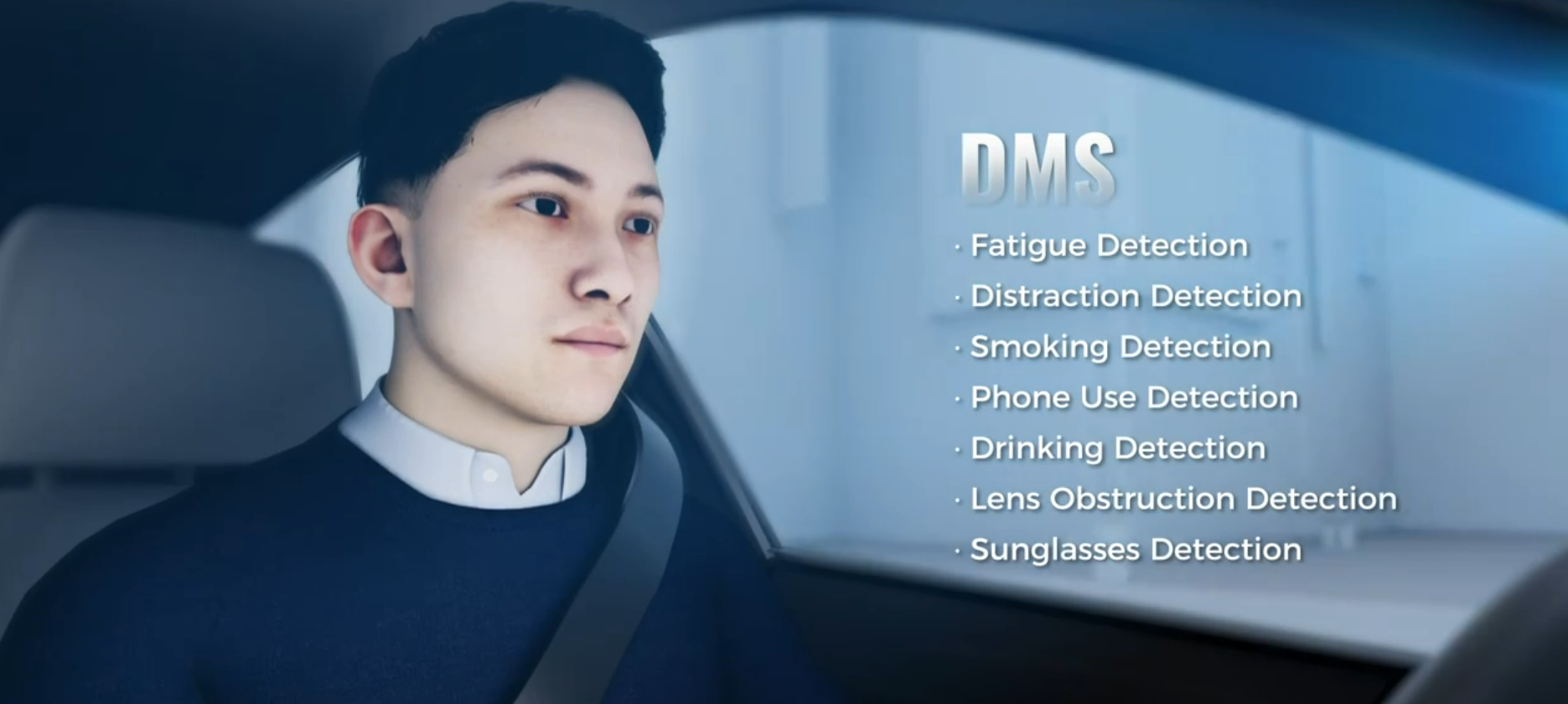
DMS stands for Driver Monitoring System. Unlike ADAS which watches the road ahead, the DMS camera is cabin-facing — it monitors the driver directly.
Using AI-powered computer vision, the DMS camera analyses the driver’s face and eye movements in real time to detect:
- Microsleep events — brief, involuntary sleep episodes often undetected by the driver
- Eye closure percentage — monitoring how frequently and how long the driver’s eyes are fully or partially closed
- Head nodding — characteristic fatigue behaviour where the head drops forward
- Distracted driving — looking away from the road for extended periods
- Mobile phone use — detecting phone handling while driving
- Seatbelt non-compliance
When a fatigue event is detected, the system responds with:
- An immediate in-cab audible and visual alert to the driver
- A real-time notification to the fleet management platform
- An automatic video clip captured and stored for review
How This Integrates with CVMS
The AI Dashcam V3 in the CVMS complete fleet kit combines both ADAS and DMS functionality in a single device. The dashcam integrates fully with the CVMS fleet management platform, meaning all fatigue and safety events are:
- Recorded automatically with timestamps and GPS location
- Visible to operations managers in real time from any device
- Stored for compliance documentation and incident investigation
- Available for driver coaching and safety review
In remote operations where vehicles are operating far from supervision — exactly the environments where fatigue risk is highest — this real-time visibility gives operations teams the ability to intervene before an incident occurs rather than investigating after.
Meeting Your Duty of Care Obligations
Under Australian work health and safety law, employers have a primary duty to ensure the health and safety of workers, so far as is reasonably practicable. For remote fleet operations, this includes managing the risk of fatigue-related incidents.
CVMS with ADAS and DMS camera technology provides documented evidence that your organisation is actively monitoring and managing fatigue risk — which is both the right thing to do and a defensible position in the event of an incident investigation.
To discuss how CVMS can support your fatigue management program, visit www.gpstrackersaustralia.au or call 02 8764 0753.