
If you manage a fleet that operates beyond the reach of Australia’s mobile networks, you already know the problem. Your driver leaves the depot heading into the Pilbara, the Kimberley or outback Queensland — and within an hour, they’ve disappeared off the radar.
No GPS ping. No check-in call. No way to know if they’re safe, on schedule or in trouble.
For fleet operators across mining, exploration, transport and agriculture, this isn’t an edge case. It’s a daily reality. And the solutions that have existed until now — expensive satellite phones, UHF radios, or simply hoping for the best — have never truly solved it.
This article explains the landscape of remote vehicle tracking in Australia, why traditional solutions fall short, and how modern Starlink-powered technology is changing everything.
Why Mobile Coverage Fails in Remote Australia
Australia is the sixth largest country in the world by area, but its mobile network infrastructure is overwhelmingly concentrated in coastal and metropolitan regions. According to the ACMA, mobile networks cover approximately 75% of the Australian population — but only around 25% of the land mass.
For fleet operators working in remote areas, this means vast stretches of road, station and mine site where standard 4G GPS tracking simply stops working. The tracker may be installed and functioning perfectly — but without a mobile signal to transmit data, it goes dark.
This affects operations across:
- Mining and resources — Pilbara, Kimberley, Goldfields and remote NT
- Pastoral and agricultural stations across outback WA, QLD, SA and NT
- Road transport on remote highways including the Great Northern, Stuart and Barkly
- Exploration and survey teams working in unmapped or low-infrastructure areas
- Construction and civil projects in regional and remote locations
The Old Solutions — and Why They Fall Short
Satellite Phones
Satellite phones have been the traditional answer for remote communication. They work — but they come with significant drawbacks. Hardware costs are high, monthly plans are expensive, and critically, most drivers find them cumbersome to use. When a driver needs to call base, they have to stop, retrieve the handset, and make a deliberate call. In practice, many don’t.
UHF Radio
UHF radios are widely used on mine sites and in pastoral operations. They’re effective at short range and within a site — but useless across the distances involved in road transport. A driver heading from Tom Price to Newman on a 200km run is well beyond UHF range within minutes.
Personal Locator Beacons (PLBs)
PLBs are emergency-only devices. They indicate distress but provide no ongoing tracking, no voice communication and no operational visibility. They’re a last resort, not a fleet management tool.
Periodic Check-Ins
Many operations still rely on scheduled radio or phone check-ins at set intervals. This works until it doesn’t — and the window between a missed check-in and a response can be dangerously long in remote environments.
How Starlink Changes Remote Vehicle Tracking
SpaceX’s Starlink low-Earth orbit satellite network has fundamentally changed what’s possible for remote connectivity in Australia. Unlike geostationary satellites that suffered from high latency and limited bandwidth, Starlink provides fast, low-latency internet connectivity across virtually all of Australia — including areas with zero mobile coverage.
The Starlink Mini hardware unit is compact enough to install inside a vehicle cab. Once connected, it provides a stable internet connection that supports GPS data transmission, live video streaming and voice communication — all simultaneously.
This is the technology that powers CVMS — the Connected Vehicle Monitoring System from GPS Trackers Australia.
What CVMS Delivers for Remote Fleet Operations
CVMS combines Starlink connectivity with a fully integrated fleet monitoring platform. Here is what it delivers in practice:
- Live GPS tracking — your operations team can see the exact position of every vehicle in real time, anywhere in Australia, regardless of mobile coverage
- Dashcam video streaming — live video feed from the vehicle’s front camera, viewable from any device at base
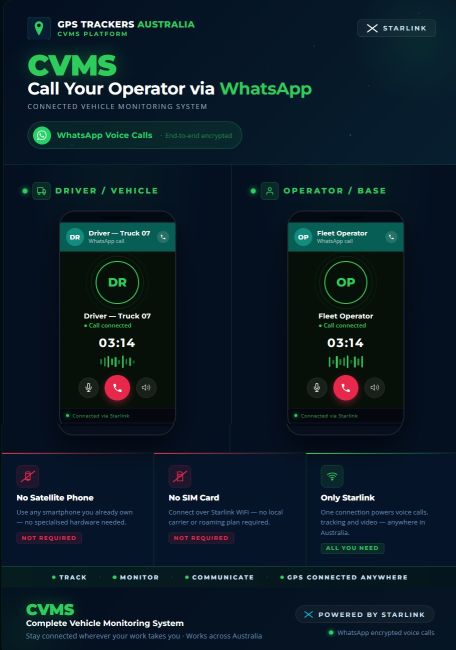
- WhatsApp voice calls — drivers can call base directly through WhatsApp using the Starlink connection. No satellite phone contract required. No SIM card needed. Just the app they already have on their phone
- Real-time alerts — speed alerts, geofencing notifications, harsh braking events and driver fatigue detection
- Automated reporting — trip history, route replays and compliance reporting all generated automatically
The CVMS Difference — No Satellite Phone, No SIM Card
The most significant practical difference between CVMS and legacy remote tracking solutions is the communication method. By using WhatsApp over Starlink, CVMS eliminates the need for a dedicated satellite phone entirely.
For drivers, this means using the smartphone they already carry — an app they’re familiar and comfortable with. For operations managers, it means a direct voice line to every driver, from base, at any time.
The cost difference is also significant. Satellite phone plans can cost several hundred dollars per month per device. CVMS operates on a single Starlink connection at a fraction of that cost.
Is CVMS Right for Your Remote Fleet?
CVMS is designed for any operation that moves vehicles through areas with limited or zero mobile coverage. If your fleet operates in remote or regional Australia — whether in mining, transport, exploration, agriculture or construction — CVMS provides the visibility and communication capability that standard GPS trackers cannot.
The system is available as a complete kit including hardware, Starlink connectivity and platform access, on a month-to-month basis with no lock-in contracts.
To learn more or book a free demonstration, visit www.gpstrackersaustralia.au or call 02 8764 0753.